


Discover how International Space Station experiments are helping scientists investigate Alzheimer’s, Parkinson’s and other neurological conditions.
Research in Low Earth Orbit is opening valuable opportunities for scientists studying the human brain and the biological processes associated with neurodegenerative diseases. Aboard the International Space Station (ISS), researchers can investigate how neural cells respond to microgravity, how disease-associated proteins behave, and how experimental treatments influence cellular damage. These findings are contributing to an expanding field of neuroscience with implications for human health.
Space research has captured public attention through its exploration of the effects of weightlessness. However, its medical significance extends into laboratories investigating some of the most challenging neurological conditions affecting older adults. Research in Low Earth Orbit is providing experimental environments in which scientists can examine cellular changes and test potential therapeutic approaches.
La Gratitude’s articles, Thriving in Northern KZN: The Elegant Choice to Relocate to Newcastle and The Urban Retiree’s Guide to a Successful Strategic Relocation, consider the importance of informed decisions, wellbeing and future care. Understanding scientific developments in neurological health adds another valuable dimension to planning for later life.
This article examines the latest relevant findings from human neural organoids, protein aggregation experiments and astronaut brain studies, explaining what these discoveries mean for future treatments and families affected by neurological disease.
1. Why are scientists studying neurodegenerative diseases in space?
Microgravity changes fluid behaviour and the mechanical environment experienced by cells. Researchers use space-based experiments to investigate neural development, protein aggregation, inflammation and cellular stress, with the aim of identifying disease mechanisms and potential therapeutic targets.
2. Can space research lead to new Alzheimer’s treatments?
Space-based experiments may contribute to drug discovery by helping scientists investigate amyloid proteins, neural injury and candidate compounds. These findings require validation through further laboratory research and clinical trials before a treatment can be considered effective for patients.
3. Does spaceflight cause neurodegenerative diseases?
Spaceflight is associated with measurable changes in brain structure, fluid distribution and certain neurological indicators. These observations do not establish that astronauts develop Alzheimer’s, Parkinson’s or another neurodegenerative disease as a result of spaceflight.
Why Scientists Are Conducting Neuroscience Research in Space
Low Earth Orbit generally extends from approximately 160 to 2,000 kilometres above Earth. The International Space Station operates at an altitude of roughly 400 kilometres, providing a specialised environment for biological experiments under microgravity conditions.
Microgravity changes the behaviour of fluids and influences mechanical forces experienced by cells. Spaceflight also involves radiation exposure and physiological changes associated with living in orbit. Scientists investigate these factors to understand how they affect biological systems.
Neurodegenerative diseases, including Alzheimer’s disease, Parkinson’s disease, amyotrophic lateral sclerosis (ALS) and frontotemporal dementia, involve complex biological processes. These may include abnormal protein accumulation, inflammation, mitochondrial dysfunction and progressive neuronal injury.
Research in Low Earth Orbit allows scientists to investigate selected processes using laboratory-grown human neural tissue. The resulting observations can help identify biological pathways that deserve further study and potential targets for future treatments.
Modern Living Flats

Basic Cottages

Modern Comfort Cottages

Comfortable Frail Care

Human Brain Organoids Reveal Important Cellular Changes
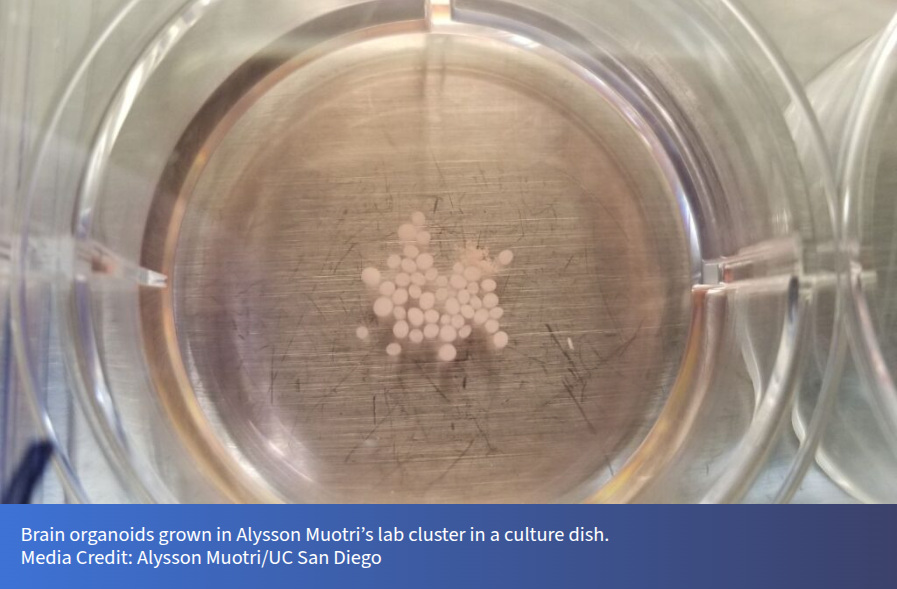
One significant development was published in Stem Cells Translational Medicine in 2024. Researchers cultured three-dimensional human neural organoids aboard the ISS, using cells derived from individuals with primary progressive multiple sclerosis (PPMS), Parkinson’s disease and unaffected control donors.
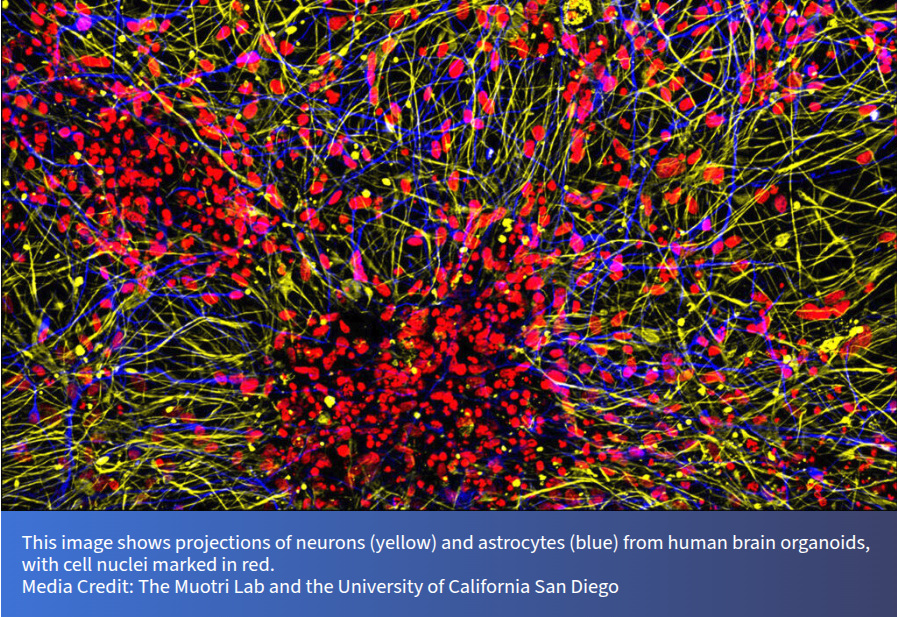
The organoids were designed to represent selected brain regions and neural cell types. Researchers also incorporated microglia, immune cells that help maintain the central nervous system. The cultures remained aboard the ISS for approximately 30 days, with Earth-based control cultures available for comparison.
The study reported changes in gene-expression patterns associated with cellular proliferation and neural maturation. These observations suggest that neural tissue can follow altered biological development under the conditions experienced in orbit.
This research establishes an important experimental capability: scientists can examine patient-derived human neural tissue in space and investigate its molecular responses. Further work is needed to determine how the observed changes relate to disease progression and whether they can support therapeutic development.
Investigating Protein Aggregation and Alzheimer’s Disease
Alzheimer’s disease involves several interacting biological processes, including the accumulation of amyloid-beta plaques and abnormal tau proteins. Understanding how these proteins assemble and interact remains an important area of neurological research.
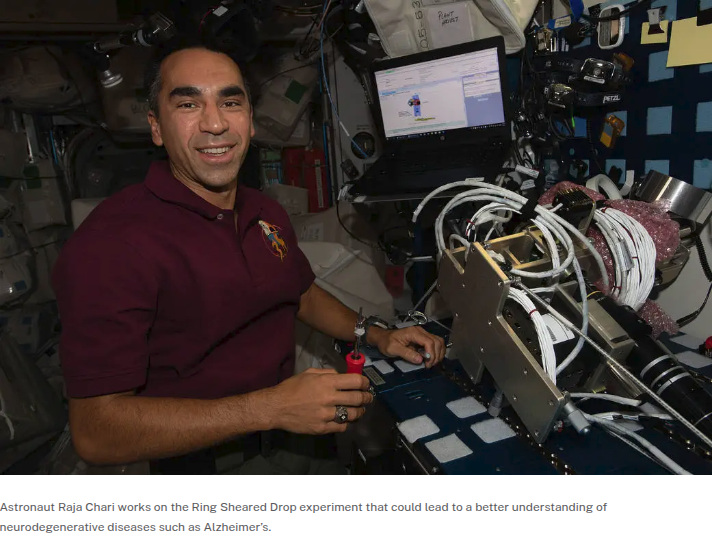
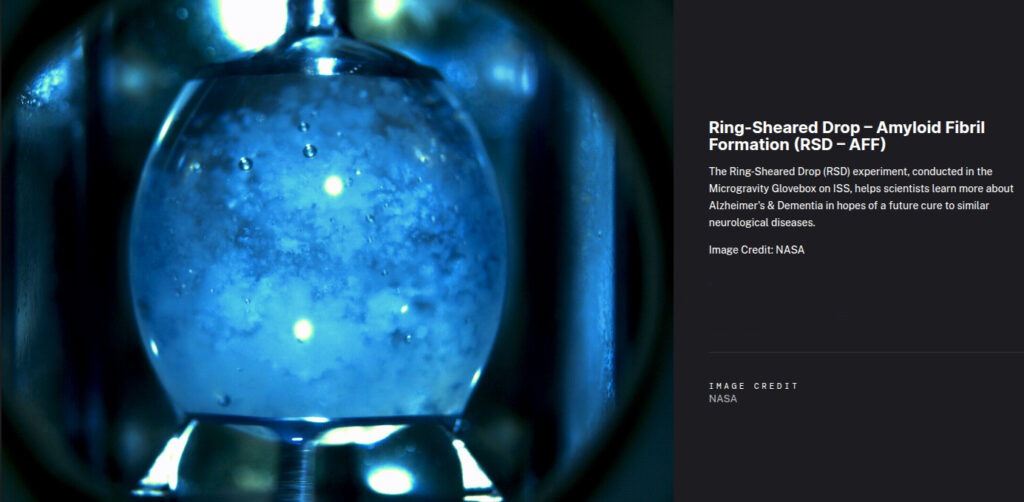
NASA’s Ring Sheared Drop investigation examines amyloid formation and fibril growth under microgravity conditions. The experiment uses surface tension to contain liquid samples, allowing scientists to investigate protein behaviour with reduced interference from conventional solid container walls.
Microgravity also changes fluid movement, including buoyancy-driven convection and sedimentation. These differences can influence the conditions under which molecules interact. Researchers can therefore investigate how fluid dynamics and interfaces affect the formation of amyloid structures.
This work contributes to the fundamental science of protein aggregation. It does not establish that microgravity automatically increases amyloid formation or that an orbital experiment can directly predict Alzheimer’s disease progression. Results must be interpreted alongside laboratory studies, disease models and clinical evidence.
The broader objective is to improve understanding of protein behaviour and identify opportunities for developing treatments that address disease-associated molecular processes.
Experimental Treatments Show Promise in Neural Tissue
Another important study, published in ACS Chemical Neuroscience in 2024, examined human motor-neuron and prefrontal-cortex organoids during a 43-day SpaceX CRS-29 mission to the ISS.
The researchers investigated biomarkers associated with Alzheimer’s disease, frontotemporal dementia and ALS. These included amyloid-beta 42, phosphorylated tau, TDP-43 and KLK-6. The study reported increased disease-associated biomarker signals in space-cultured organoids relative to Earth-based controls.
The team also investigated two experimental compounds, NI112 and NI113, targeting NF-κB and interleukin-6-associated inflammatory signalling. Treatment reduced several disease-associated biomarker signals in the experimental tissue.
These findings provide a promising basis for further preclinical investigation. They suggest that neural organoids exposed to defined biological stresses may offer a useful platform for evaluating candidate compounds and identifying therapeutic targets.
The compounds remain experimental. The findings do not establish clinical efficacy or an approved treatment for Alzheimer’s disease, ALS or frontotemporal dementia. Further research must evaluate reproducibility, toxicity, pharmacology and functional outcomes before human therapeutic applications can be established.
What Astronaut Brain Studies Tell Us About Neurological Health
Research involving astronauts provides another important perspective. Scientists have used magnetic resonance imaging (MRI) to examine brain structure and fluid distribution before and after spaceflight.
A study published in JAMA Neurology in 2019 analysed preflight and postflight imaging from 15 astronauts. Researchers observed changes in extracellular fluid distribution and white-matter microstructure following spaceflight. Some changes were associated with mission duration and postflight balance performance.
These findings demonstrate that spaceflight can produce measurable neurological changes. They also highlight the importance of understanding how fluid redistribution and physiological adaptation affect the brain.
Cerebrospinal fluid surrounds the brain and spinal cord, supporting their protection and chemical environment. Spaceflight-associated fluid shifts have prompted further research into intracranial pressure, neurological biomarkers and spaceflight-associated neuro-ocular syndrome.
Such research may inform investigations of protein transport, cellular waste clearance and neurological injury. Scientists must establish the extent to which these mechanisms overlap with those implicated in neurodegenerative diseases before drawing conclusions about disease risk or treatment.
What These Discoveries Could Mean for Future Treatments
Research in Low Earth Orbit has potential applications in drug discovery, disease modelling and the investigation of neuroprotective strategies. Patient-derived neural organoids allow scientists to examine selected biological characteristics associated with individual diseases and evaluate how cells respond to experimental interventions.
Gene-expression analysis can reveal changes in cellular pathways. Biomarker measurements can help researchers assess biological responses, while controlled treatment experiments can identify compounds that warrant further investigation.
These approaches are relevant to conditions affecting older adults, including Alzheimer’s and Parkinson’s disease. They may also contribute to research into ALS, frontotemporal dementia and other disorders involving neuronal dysfunction.
Nevertheless, laboratory findings require careful validation. Neural organoids reproduce selected features of human neural tissue and cannot fully represent the architecture, circulation, immune environment or long-term functioning of a living brain. Changes in a biomarker also do not necessarily predict improvements in memory, movement or independence.
Scientific progress depends on combining space-based experiments with Earth-based laboratory studies, appropriate preclinical research and carefully designed clinical trials.
Conclusion: The Growing Value of Neuroscience Research
Research in Low Earth Orbit is expanding scientific understanding of neural maturation, protein aggregation, inflammation and the biological effects of spaceflight. Studies aboard the ISS have demonstrated that human neural organoids can be investigated in orbit, while experimental compounds have shown encouraging effects on selected disease-associated biomarkers in laboratory models.
These developments offer meaningful opportunities for future neurological research. They also reinforce the importance of continued investigation into conditions that can affect independence, family life and quality of life during older age.
For individuals and families planning for retirement, staying informed about medical research supports thoughtful discussions about health, wellbeing and future care needs. Scientific discoveries require time and rigorous validation before they can translate into established treatments, yet each carefully conducted study contributes to the knowledge available to researchers and healthcare professionals.
At La Gratitude, we recognise that informed planning and quality retirement living go hand in hand. Our community in Newcastle, Northern KwaZulu-Natal, offers independent living accommodation, beautiful garden surroundings, a secure environment and a supportive community.
Visit our homepage at https://lagratitude.co.za to learn more about retirement living at La Gratitude, or contact our team to discuss accommodation and care options. We welcome you to arrange a viewing and discover the facilities available to support your next stage of life.
Citations
- Marotta, D. et al. (2024). Effects of microgravity on human iPSC-derived neural organoids on the International Space Station. Stem Cells Translational Medicine.
https://doi.org/10.1093/stcltm/szae070 - Sharma, S. et al. (2024). Inflammasome-Inhibiting Nanoligomers Are Neuroprotective against Space-Induced Pathology in Healthy and Diseased Three-Dimensional Human Motor and Prefrontal Cortex Brain Organoids. ACS Chemical Neuroscience.
https://doi.org/10.1021/acschemneuro.4c00160 - NASA. Ring Sheared Drop (RSD).
https://science.nasa.gov/biological-physical/investigations/rsd/ - Lee, J. K. et al. (2019). Spaceflight-Associated Brain White Matter Microstructural Changes and Intracranial Fluid Redistribution. JAMA Neurology, 76(4), 412–419.
https://doi.org/10.1001/jamaneurol.2018.4882 - Roberts, D. R. et al. (2017). Effects of Spaceflight on Astronaut Brain Structure as Indicated on MRI. New England Journal of Medicine, 377, 1746–1753.
https://doi.org/10.1056/NEJMoa1705129 - NASA. Science in Space: The Brain in Microgravity.
https://www.nasa.gov/missions/station/iss-research/science-in-space-aug-25-2023-the-brain-in-microgravity/
Thank you for your continued support, we appreciate your likes, follows and retweets on Facebook, Twitter, Pinterest and LinkedIn. Make sure to share this post with friends and family.
You can make a difference

With your assistance, the volunteers at La Gratitude will be able to take better care of not only the residents at the old age home but also the greater Newcastle community. La Gratitude is constantly involved in outreach projects to help the elderly in need in and around Newcastle.
Your donations will be greatly beneficial in the provision of food and other basic necessities for the less fortunate elderly people that require assistance.
Donating is easy, click here to donate now.


